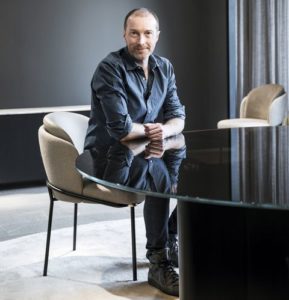
Born in Sfax, Tunisia, in 1959 to an English father and a French-Latvian mother, Tom lived in Egypt and Morocco before spending his childhood in London. Tom attended Holland Park Comprehensive, which had a decent pottery department and Life Drawing class, which was where the initial obsession with materiality, manufacturing, and form took shape.
Leaving school at 18 Tom tried six months at art school which disagreed with him. He left following a motorcycle accident that left him with a broken leg.
“If I had spent more time at art school, I would have been told to do this, or not to do that. There was great liberation in just being able to make different things using found objects, without having to justify myself.”
A new found passion for welding allowed Tom to teach himself to make tough metal structures – his hobby rapidly expanded into a knack for making furniture from found objects. The welded salvage furniture quickly found a clientele and as a result Dixon evolved seamlessly over the next few years from welder to craftsman to designer.
International exhibitions followed and as a result, Tom was courted by forward looking Italian luxury furnishing manufacturers such as Cappellini. Several products were put into mass production and gained a broader recognition culminating in products attaining positions in the permanent collections of the Museum of Modern Art, The Victoria & Albert Museum, The Design Museum and many more.
A doodle of a chicken turned into an idea for a chair, that went through a series of mutations and resulted in the S-chair. An unusually sculptural seat that took Dixon from self-production into the Italian luxury goods industry, and from there into the permanent collection of the Museum Of Modern Art in NYC.
In 2002, The Tom Dixon brand is founded in London and production starts on a line of extruded plastic products.
“Now, with a fresh and eponymous company, I start on a new phase and the main challenges remain the same: balancing risk and ambition in design with economics of production and sales; searching from the new and learning from the old; tackling all the usual questions that come up like aesthetic pleasure versus utility and sustainability, durability versus disposability, best practice with advanced technologies and unorthodox materials and, most unpredictably of all, what people might actually like enough to spend their hard-earned cash on.”
Responsible for iconic designs such as the Mirror Ball lamp, Copper Shade light, Wingback seat, Fan chair and Beat Light, Tom Dixon’s S-Chair is currently in the permanent collections of London’s Victoria and Albert Museum and New York’s Museum of Modern Art, and his company now sells in 65 countries with permanent offices in London, New York and Hong Kong.