DESIGNER’s STORY

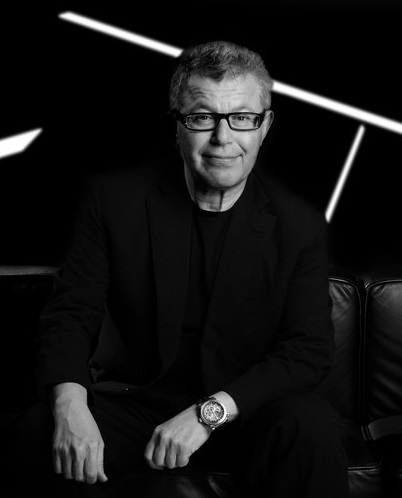
Daniel Libeskind

As an international architect and designer, DANIEL LIBESKIND, B.Arch M.A. BDA AIA, is committed to expanding the scope of architecture to involve philosophy, art, literature and music. Fundamental to Libeskind’s philosophy is the notion that buildings are crafted with perceptible human energy, and that they address the greater cultural context in which they are built.

Daniel Libeskind established his architectural studio in Berlin, Germany in 1989 after winning the competition to build the Jewish Museum in Berlin. In February 2003, Studio Daniel Libeskind moved its headquarters from Berlin to New York City when Daniel Libeskind was selected as the master planner for the World Trade Center redevelopment. Daniel Libeskind’s practice is involved in designing and realizing a diverse array of urban, cultural and commercial projects internationally. In addition to the New York headquarters, Studio Libeskind has European offices based in Zürich, Switzerland (Architekt Daniel Libeskind) and Milan, Italy (Libeskind Architettura & Libeskind Design.)

Last year Studio Daniel Libeskind celebrated the completion of the City Life residences, part of the redevelopment of the historic Fiera Milano Fairgrounds in Milan, and Kö-Bogen, an office and retail complex in Düsseldorf. The Studio has several projects under construction including three high-rise residential developments: The L Tower in Toronto, Zlota in Warsaw, and Vitra in Sao Paulo; two projects in Asia, the Zhang ZhiDong and Modern Industrial Museum in Wuhan and Corals at Keppel Bay in Singapore; as well as the Centre des Congrès in Mons, Belgium.

Over the years, Daniel Libeskind has been fortunate to be commissioned by a number of international clients to develop a diverse array of products, bespoke furniture, and interior designs. To this end, he chose to establish Libeskind Design in Milan, the international center for design, with unparalleled artisans, care for detail and connections to the broader world of contemporary architecture and art. The product designs reflect Libeskind’s interest in the world of everyday objects, and the stories they tell about the people who use them.

READ MORE BRAND DESIGNER’s STORIES

Rodolfo Dordoni

Born in 1954, member of the Milanese tradition that generated designers such as Castiglioni, Zanuso, Magistretti and de Lucchi, graduated in architecture at the Politecnico of Milan in 1979. Since then, he has designed for most of the leading names in the furniture and lighting sectors. Minotti and Rodolfo Dordoni: the company started working with


Read More »

Marcio Kogan

Born in São Paulo, Kogan is the founding architect and professor of all the team at studio mk27. As the architects of the team, Kogan is a great admirer of the Brazilian modernism generation, seek to fulfill the task of rethinking and giving continuity to this iconic architectural movement. The projects of studio mk27 place

Read More »

Vico Magistretti

Vico Magistretti was born in 1920, in Milan. In the post-war period he was actively involved in the reconstruction, both on the theoretical side through the MSA (Movement for Architectural Studies) of which he was one of the founders, and on the practical side with projects for INA-Casa and QT8.

Read More »

Romeo Sozzi

As the third generation of specialized wood craftsmen in cabinet making and restoration, in the seventies, Romeo Sozzi made his debut in interior decoration. Since 1988, he has managed his company, Promemoria, together with his three sons. In time, Promemoria has become not just a producer of internationally high profile furnishing, but a test bed

Read More »

Bruno Moinard

An authoritative presence on the contemporary French scene, Bruno Moinard has developed commercial and cultural projects for an international clientele, from Christie’s to Cartier, from Galerie Lafayette to the Musée des Arts Decoratif.

Read More »

Nendo Design

Since 2002 with Oki Sato providing direction to Nendo studio, it represents a refreshing, refined and cultured alternative to over-celebrated design. Meaning “clay” in Japanese the name Nendo implies the flexibility and malleability of that material their designs for the world of graphics, interior architecture and furniture.

Read More »
Scroll to Top